 The container shipping industry is facing an increasingly deteriorating scenario of supply-demand imbalance, spiraling debts, and market uncertainties that is prompting “profound structural changes” in the sector, according to a new industry analysis.
AlixPartners’ “2014 Container Shipping Outlook” says the industry remains buried under a growing mountain of debt amid continued market turbulence. The prolonged and widespread financial distress is spurring a new development that sees a number of “profound structural changes to the industry—changes that may result in broad-ranging impacts on the major market participants.”
The race to build and deploy the largest, most efficient vessels is “both a cause and an effect of the persistent financial pressure,” the report said. It has pushed the unprecedented move toward carrier alliances on major trade lanes as demand consistently fails to keep up with supply.
Container carriers’ financial performance points toward continued market turbulence. Only five of the 15 carriers included in the study saw their scores improve in 2013 from 2012, and those increases appear to be very modest.
This “indicates that the market as a whole has suffered during the past year, falling deeper into the risk of the severe distress range,” observed the outlook.
“Although the container shipping industry has for decades been subject to a vicious cycle of mismatches in supply and demand, this time the cycle has been different: there has been no sustained period of recovery—no seller’s market—in which the carriers could rebuild their finances,” it added.
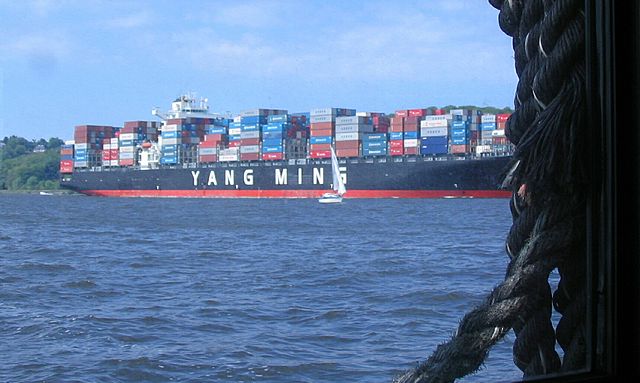
Global container-fleet capacity rose by less than 6 percent since 2012 but an increasing amount of that investment has been dedicated to mega vessels that are seen to deliver advances in fuel efficiency and other scale economies. But the cost benefits have failed to materialize due to weak demand.
In an effort to fill these mega ships, consolidation is now taking place through new alliances, such as the G6 alliance, formed at the end of 2011, and the P3 alliance—announced last year by Maersk Line, Mediterranean Shipping Co., and CMA CGM. The latter was given clearance this month by the U.S. Federal Maritime Commission to operate on the three East-West trades: Asia-Europe, trans-Pacific, and trans-Atlantic.
Moreover, Hapag-Lloyd and CSAV announced their intention to merge, which would form the fourth largest global container shipping line.
More capacity in fewer hands will have spillover effects on both port operators, faced with increased inter-port competition, and shippers, faced with fewer service options and reduced supply chain flexibility, said the study.
“Carriers face a prolonged fight for survival—especially those facing heavy debt burdens. The emergence of strong operational alliances at the same time as the rolling out of larger tonnage has divided the sector into haves and have-nots, with smaller lines left with tough choices,” said the outlook.
It advised shippers to consider the following procurement strategies for 2014:
- Closely monitor the financial health of the carrier base.
- Keep a non-vessel-operating common carrier in the mix as a safety move should the market tighten unexpectedly.
- Avoid over-consolidating the carrier base. Key carrier programs have drawbacks as well as the well-publicized benefits.
- Benchmark rates and service levels via objective third-party resources.
- Consider index-linked or long-term contracting options if operating with high volumes on lanes with low volatility.
- Pay carriers for bunker fuel via a clearly defined—and fair— fuel surcharge program.
Said the outlook: “The widespread financial distress that has long plagued the industry is driving a number of profound structural changes that may have broad-ranging impact on key market participants. In this environment, carriers, their customers, and investors can take a series of strategic steps to preserve value and position themselves for success.”
Photo: Martin Pettitt