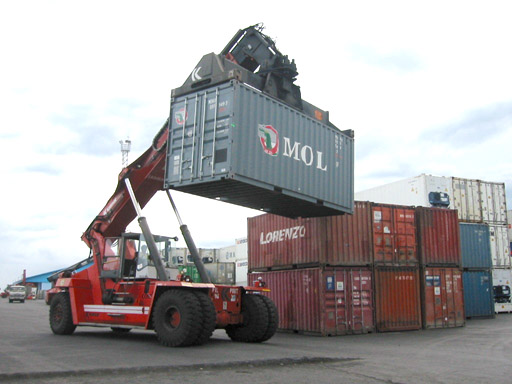

 Sasa Wharf in Davao in the Philippine island grouping of Mindanao is looking at a cargo volume increase of 8-10% in the next three years even if the new international container terminal adjacent to the port goes online next year.
Sasa Wharf officials said cargo volume will even swell when the new private commercial port starts full commercial operations by next year.
Sasa Wharf is managed by Philippine Ports Authority. The facility’s cargo handling operator is Davao Integrated Port Stevedoring Services, Corp, a subsidiary of Manila-based International Container Terminal Services, Inc.
Privately held Anflocorp Group will construct a P2.7-billion international container terminal complex using the wharf of former Tagum Development Corp, a company also owned by Anflocorp. The group has contracted the services of Aboitiz Construction to build the terminal. Construction is set to start this quarter and completion by 2013.
The terminal is designed to handle 240,000 twenty-foot equivalent units within the first quarter of operations. Anflocor said it decided to invest in the project with the swelling volume of export cargo, particularly bananas and pineapples, to and from the region.
“We are not worried that the planned new container terminal will take volume away from Sasa Wharf,” port manager Christian Santillan told PortCalls in a recent interview, noting that the new facility will only be an alternative to Sasa which will continue to be the region’s main port.
“We even encourage competition… as it will result in efficiency and better value-added services,” Santillan said.
“Sasa cannot handle all the traffic alone and, in fact, any spillover from the new container terminal would go to us resulting in higher cargo volume.”
Santillan said cargo volume will continue to be dominated by foreign cargoes, particularly banana export shipments.
Port stats
In the first 10 months of 2011, Sasa Wharf handled 556,351 twenty-foot equivalent units (TEUs), of which 386,355 TEUs were international containers and 170,016 TEUs, domestic containers.
Export containers for the period reached 199,575 TEUs with full container load (FCL) at 159,839 TEUs and empties at 39,736 TEUs.
Import containers hit 186,760 TEUs, of which 61,641 TEUs were FCL and 125,119 TEUs, empties.
Domestic inbound cargo totaled 94,436 TEUs. FCL reached 78,661 TEUs, less than container load (LCL) 1,845 TEUs, and empties 13,930 TEUs.
Domestic outbound containers hit 75,580 TEUs. FCL represented 40,746 TEUs, LCL 8,334 TEUs, and empties at 26,510 TEUs.
Passenger volume the period totaled 898,892, with disembarking passengers representing 461,287 and embarking passengers, 437,605.
Photo from http://www.ppasomin.com.ph/





