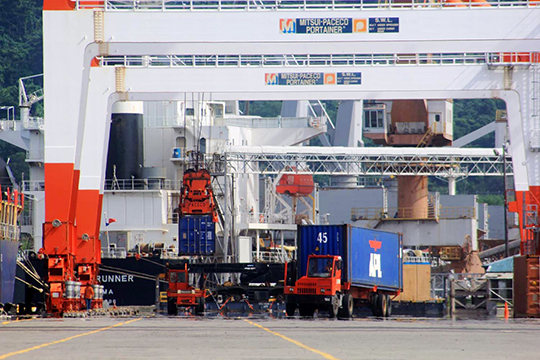


Container volume handled at Subic port surged 104.6% to 76,652 twenty-foot equivalent units (TEUs) from January to December 2014 from 37,469 TEUs for the whole of 2013.
Subic also exceeded by 2.2% the revised target of 75,000 TEUs by year-end. Initially, Subic Bay Metropolitan Authority’s (SBMA) target for 2014 was only 70,000 TEUs.
Record-high traffic for a single month was posted last November when the port handled 14,175 TEUs, 434.1% more than the 2,654 TEUs posted in the same month last year.
Much of the growth in traffic can be attributed to shippers now moving their shipments through Subic to avoid port congestion in Manila.
Danish carrier Maersk Line had its first ad-hoc call at Subic port last January 3 while Japanese liner NYK also started calling in December. Both shipping lines connect Subic to Singapore.
Subic’s regular callers include Wan Hai, APL, Swire Shipping and SITC.
New terminals proposed
With the growing volume, SBMA is proposing to the National Economic and Development Authority a plan to expand Subic port by adding new terminals for completion in three years’ time.
Marco Estabillo, SBMA operations group senior deputy administrator, in a phone interview with PortCalls said the authority plans to add New Container Terminals (NCT) 3 and 4 to the existing NCT 1 and 2.
Each new terminal will have an annual capacity of 300,000 TEUs that will double Subic port’s current capacity to 1.2 million TEUs.
To accommodate the expected growth in volume from the land side, SBMA is also proposing the widening of the existing Tipo road at a cost of P1.4 billion, and construction of the P11.5-billion new access road from Mabiga, Hermosa Bataan to Subic Bay Freeport.
Moreover, SBMA, in coordination with the Subic Bay International Terminal Corporation, operator of the Subic container terminals, intends to open a temporary one-stop shop (OSS) in the first quarter of 2015.
The OSS will house the offices of the SBMA, Bureau of Customs, and other government agencies that are needed for clearing shipments. Port users requested for an OSS as the buildings of these agencies are scattered throughout the Subic Bay Freeport Zone. – Roumina Pablo





