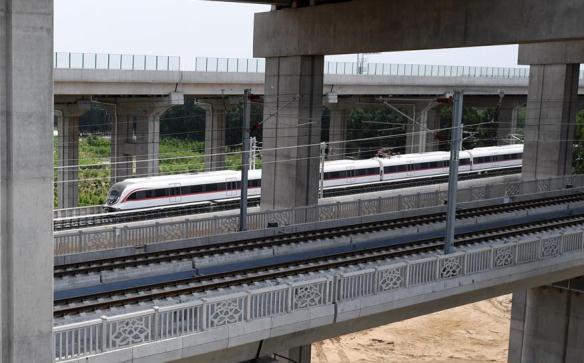
 Self-driving trains for the subway line connecting downtown Beijing to the new Beijing Daxing International Airport have commenced their trial run, according to local authorities.
Stretching 41.4 kilometers, the new line began its test run on June 15. It supports an autopilot system and can run at a speed of 160 km per hour with up to 448 passengers, according to Beijing Major Projects Construction Headquarters Office.
The subway line goes through Daxing and Fentai, two districts in the southern part of Beijing, and will take only 19 minutes to get from the Caoqiao station in Beijing’s south third ring road to the new airport, which is slated to start operations by the end of September.
The line is part of an integrated transport network that will combine subways, expressways, intercity rail and high-speed rail, with the airport at the center.
Phase 1 of the line is 41.4 km, including 17.71 km of elevated section and 23.65 km of underground section.
A 3.5 km northern extension to Lize Business District station is currently under planning. After the northern extension finished, the line will be 44.86 km long.
Beijing Daxing International Airport, located on the border of Beijing and Langfang, Hebei Province, is the capital city’s second international airport. Construction of the airport began on December 26, 2014 and the hub is nearing completion.
The terminal building, the second largest single-building airport terminal after Istanbul Airport, is expected to be completed on July 15, 2019, and the airport is expected to open on September 30, 2019.
The multi-billion-dollar airport completed its first passenger airline test flight last May 13.
A number of advanced Chinese radar systems have also been set up to provide faster and more accurate weather forecasts and enable early warning of low-visibility conditions.
On completion, Beijing Daxing airport will serve as a second international airport for Beijing, designed to relieve existing pressure on Beijing Capital International Airport.
Photo courtesy of Xinhua/Zhang Chenlin