
 Asia-U.S. carrier group Transpacific Stabilization Agreement (TSA) is recommending general rate increases (GRIs) in the next two months as well as a peak season surcharge (PSS) in July. The proposal comes as they predict strong volumes in the second quarter following a 3% year-on-year cargo growth in the first quarter.
Saying the carriers need to improve revenue to meet demand as the West Coast congestion eases, TSA said it is recommending US$600 per 40-foot container (FEU) rate increases on June 1 and July 1, as well as a PSS of $400 per FEU, to take effect on July 1.
The increases, TSA said, are intended to counter recent erosion in market rates, while the PSS will help cover contingencies from seasonal cargo surges.
“The entire transportation and logistics sector is still digging out from a very difficult period, and all parties are eager to return to a more stable, predictable environment in moving goods to market,” said TSA executive administrator Brian Conrad. “We’re fortunate that the U.S. consumer remains strong, port throughput is improving, and operational chokepoints have eased. But it must be remembered that baseline service levels come at a cost.”
Conrad emphasized that while overcapacity in the market will likely remain a consideration through 2016, it will not represent a major challenge. He also refuted recent reported analyst forecasts of more than 20% overcapacity on U.S. East Coast services and downward pressure on freight rates, saying these are mainly based on faulty assumptions.
These wrong notions, he added, include using nominal shipyard-rated capacity of new vessels entering the trade and not the effective capacity after adjusting for vessel loading, berth and terminal capacity, and other factors.
Others are double-counting services launched as much as a year ago as new; overlooking the longer-term shift in demand to East Coast and Gulf Coast services, particularly via Suez; and assuming that most traditional West Coast traffic will return to West Coast ports once the current congestion situation ends.
“Our carriers see a very different set of facts on the ground,” Conrad said, “with perhaps a 15% net capacity increase in a market segment that grew by 10% last year and by an annualized 22% in the first quarter—nearly half of that the result of organic growth, not congestion-related cargo diversion.”
He added that East/Gulf Coast vessel utilization remains in the 95% to 100% range as of mid-April, and that lingering uncertainty over how much discretionary cargo shippers will resume moving via the West Coast makes it essential that carriers be prepared for contingencies going forward.
TSA is a research and discussion forum of major container shipping lines serving the trade from Asia to ports and inland points in the U.S. Members include APL, China Shipping Container Lines, CMA-CGM, COSCO Container Lines, Evergreen Line, Hanjin Shipping Co., Hapag-Lloyd, Hyundai Merchant Marine, Kawasaki Kisen Kaisha, Maersk Line, Mediterranean Shipping Co., Nippon Yusen Kaisha, Orient Overseas Container Line, Yangming Marine Transport, and Zim Integrated Shipping Services.
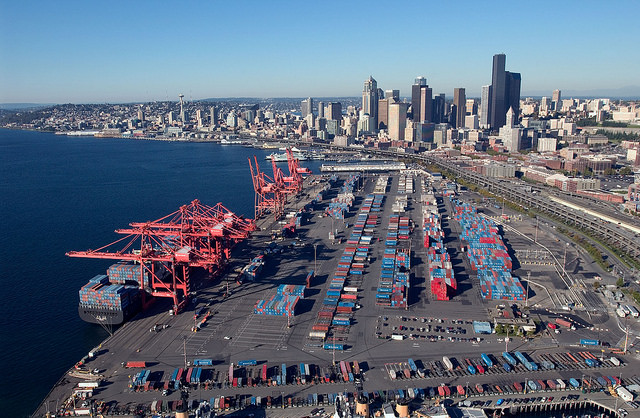
Photo: Nacto Credit Don Wilson