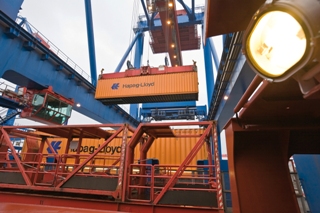
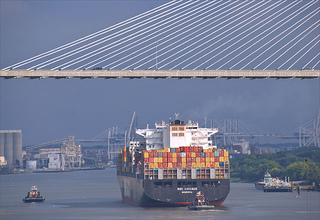
 The Trans-Pacific Stabilization Agreement (TSA) has recommended a two-stage increase in freight rates in December and the pre-Lunar New Year period in January 2014, saying the late holiday season shipments during this time represent “pockets of particular strength in the Asia-U.S. trade and an opportunity for badly needed revenue recovery.”
TSA, a research and discussion forum of major container shipping lines, suggested across-the-board increases of US$200 per 40-foot container effective December 20, 2013, and $300 per FEU effective January 15, 2014.
With freight rate levels in the trade still well below sustainable levels in the trade, even after achieving partial success with a previous November 15 increase, carriers said it was critical to “take full advantage of any periods of strong demand and continue to build a healthier revenue baseline for upcoming contract negotiations.”
“The central truth in this market is that every carrier is operating at a loss,” said TSA executive administrator Brian Conrad. “Some may achieve net profit from cost cutting, but the revenue line in each case is lower, and that has long-term service implications for customers.”
Conrad acknowledged the difficulty of raising rates in a highly competitive market, but said that pressures on carriers from capital markets and parent companies to improve profitability are gradually overtaking supply-demand considerations.
“There is an unrealistic perception that we have a huge capacity gap from Asia to the U.S. and therefore that rates charged in the short-term transactional market should serve as benchmarks for the entire trade in 12-month contracts,” Conrad said. “This thinking devalues the service provided, ignores rising fuel, equipment and operating costs, and has now begun to affect the ability of container lines to access capital markets and even government support for the future.”
TSA lines added that the revenue situation is sufficiently serious that, irrespective of perceived supply-demand and other market conditions, they see the scheduled December and January rate adjustments as setting the table for significant additional increases contained in 2014-15 contracts.
TSA consists of 15 major container shipping lines serving the Asia-U.S. trade. These are APL, China Shipping Container Lines, CMA-CGM, Cosco Container Lines, Evergreen Line, Hanjin Shipping, Hapag-Lloyd, Hyundai Merchant Marine, Kawasaki Kisen Kaisha, Maersk Line, Mediterranean Shipping Co., Nippon Yusen Kaisha, Orient Overseas Container Line, Yangming Marine Transport Corp., and Zim Integrated Shipping Services.
Photo: Ron Cogswell