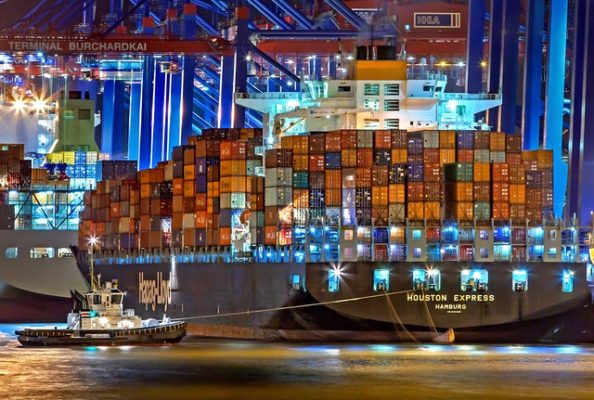
 A tough year awaits the container shipping market in 2019, as the long-haul mainlane trades are expected to see lower demand and face several pitfalls in the coming months, according to the Baltic and International Maritime Council (Bimco).
Trade tensions between the U.S. on one side and China and Europe on the other and a seeming saturation of traditional markets in the West, particularly in Europe, could adversely impact mainlane trades.
Bimco predicts European containerized imports “to be stuck with demand growth of no more than 2% for years to come,” and overall imports into the U.S. to “be lower in 2019 when compared with 2018.”
Lukewarm demand on the main trades is also likely to have an impact on intra-Asian trade lanes that benefit from exports to Europe and North America, said the organization.
Except for 2015, growth in the first 11 months of 2018 was the slowest recorded in the past decade for intra-Asia at 3.8%.
The good thing is that freight rates on many intra-Asian trades have been steady throughout 2017-2018, which is very positive in a market that is growing at continued slower pace. But Bimco says it remains to be seen how steady these rates will be going forward when extra-Asia trades weaken, and whether intra-Asian trade lanes, supported by the regional demand for container shipping, continue growing at a high-enough pace.
Meanwhile on fleet growth for 2019, Bimco is forecasting a 3.4% container-fleet expansion. The scheduled order book for 2019 deliveries stands at nineteen 19,000+ TEU ships; thirty 11,800 to 15,300 TEU ships; zero 3,621 to 11,800 TEU ships; and 129 ships with a TEU capacity of less than 3,621 TEUs.
Binco expects a 20% slippage rate for the container shipping order book—the lowest among the main shipping sectors.
At the same time, Bimco said it “cautiously observe a renewed interest in Ultra Large Containerships with orders up from nine units in 2016 to 36 in 2017, and reaching 40 in 2018, plus many sub-3,000 TEU ships. In total, more than two million TEU of new capacity was ordered during 2017-2018.”
Bimco observed that the dominant theme for 2019 will be the sharing of the higher costs that are expected in various forms towards the end of the year, as the starting line for the IMO 2020 sulfur cap approaches.
These increased costs will come either as a result of purchase of fuels, which are more expensive than heavy sulfur fuel oil (HSFO), or because of investments in abatement technologies that will allow carriage and consumption of HSFO past the March 1 and January 1 deadlines.
“Unless these costs can be passed on to the end consumer through the whole supply chain, profit margins in the container shipping industry will be reduced everywhere; a failure to recover the extra fuel costs in full may even result in outright bankruptcies in the container shipping industry,” said Bimco.