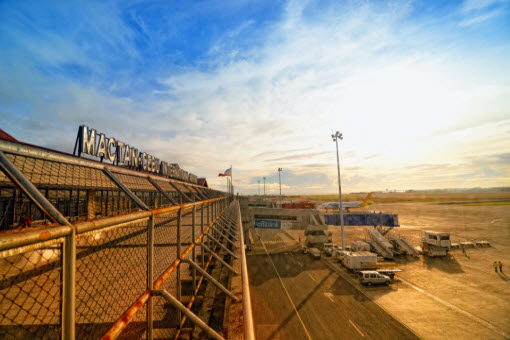

 SEVEN pre-qualified groups last week bid for the P17.5-billion Mactan-Cebu International Airport (MCIA) project, the first airport put on the block under the Aquino administration’s Public-Private Partnership (PPP) program.
The bidders are: AAA Airport Partners led by the Ayala and Aboitiz companies; the Filinvest-CAI Airport consortium; the Lopez groups’ First Philippine Airports; the GMR Infrastructure and Megawide consortium; the MPIC-JGS Airport consortium led by the companies of Manuel V. Pangilinan and John Gokongwei; SM’s Premier Airport Group; and the San Miguel-Incheon Airport consortium.
The foreign airport operators include ADC & HAS of Houston Airport, Malaysia Airports Bhd, and those from Singapore’s Changi Airport, South Korea’s Incheon Airport, France’s Aeroports de Lyon, Switzerland’s Zurich Airport, India’s Delhi Airports.
Department of Transportation and Communications (DOTC) spokesman Michael Arthur Sagcal said the high turnout of bidders indicated growing investor confidence.”We want to sustain the momentum from this project to the next ones in our pipeline,” he said.
The National Economic and Development Authority (NEDA) Board recently approved key improvements to the project’s terms to make it more attractive to bidders.
The improvements include extending the concession period from 20 years to 25 years, including the operation of the apron or aircraft parking area in the project scope, and imposing a 25-year ban on the operation of competing airports within Cebu province, apart from the Bantayan and Camotes islands.
The MCIA project involves construction of a new world-class international passenger terminal building with a capacity of about 8 million passengers per year; renovation and expansion of the existing terminal, whose annual passenger traffic of 6.7 million passengers exceeds its design capacity; installation of all the required equipment; and the operation of both new and existing facilities.
When the terminal is completed, the existing terminal, which caters to both domestic and international passengers, will then be converted into an exclusively domestic passenger terminal.
Meanwhile, the DOTC’s P1.72-billion Automatic Fare Collection System (AFCS) project received the highest number of bidders for a PPP project, with five groups participating.
The DOTC is now evaluating technical proposals submitted for both the AFCS and MCIA projects. It is targeting to proceed to the opening and evaluation of financial proposals next month.
The bidding process for another project, the P 64.9-billion Light Rail Transit Line 1 Cavite Extension (LRT-1 Cavex) will begin this week, when the transport agency will publish its invitation to bid.
DOTC obtained the NEDA Board’s approval to improve the project’s economic terms, and has announced it intends to conduct bidding in the second quarter of 2014, to allow new players to join in.
“We’d like the number of LRT-1 Cavex bidders to be more or less in the range of the MCIA and AFCS projects. This will encourage more competitive proposals, which will be good for government,” Sagcal said.
Photo from ppp.gov.ph