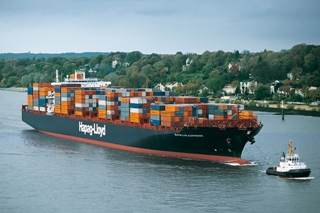

 Hapag-Lloyd said it will implement a peak season surcharge (PSS) for all cargo and all container types from East Asia (excluding Japan) to North Europe.
The PSS is US$350 per TEU, effective from August 1, 2012 to September 30, 2012.
The German ocean carrier will also impose a general rate increase (GRI) of $250 per TEU on all cargo and all container types from East Asia (excluding Japan) to North Europe with effect from August 15, 2012.
The Hamburg-based box ship likewise said it plans to extend through August the PSS of $250 per TEU on trade from North Europe to East Asia (including Japan), the Middle East, and the Indian Subcontinent.
The peak season surcharge, introduced last May 1, was initially to end July 2012.
North Europe is comprised of the North West Continent, UK, Scandinavia, Baltic, and European ports of Russia.
East Asia consists of Japan, Korea, Taiwan, Hong Kong, China, Macao, Singapore, Malaysia, Myanmar, Indonesia, Thailand, Philippines, Papua New Guinea, Laos, Cambodia, Vietnam, Brunei, and the Russian Pacific ports of Vladivostok and Vostochny.
The Middle East is comprised of the Persian Gulf and Red Sea destinations.
The Indian Subcontinent is made up of India, Pakistan, Bangladesh, and Sri Lanka.
Photo: Hapag-Lloyd