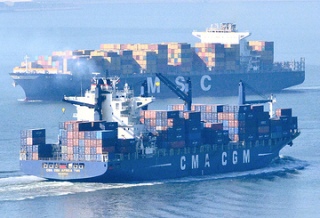

 The recent decision of Maersk Line, MSC, and CMA CGM to form a mammoth vessel-sharing alliance in the three major east-west trades will have an impact not just on shippers but on port operators as well, according to Drewry Maritime Research.
“The ramifications of the consolidation for the port industry are enormous,” the consultancy and research company said in a report on the Drewry Container Insight. “Each of the three carriers already operates more ULCVs [ultra-large container vessels] than anyone else, so catering for their combined cargo handling requirements will be on a scale never seen before.”
Maersk Line, MSC, and CMA CGM announced earlier that they intend to share vessels in the Asia-Europe, trans-Pacific, and trans-Atlantic trades from the second quarter of 2014. A total of 255 ships will be operated in 29 loops with a combined capacity of 2.6 million TEUs (20-foot-equivalent units).
Among potential concerns of the port industry is whether the three will consolidate or rationalize their port calls. “While economies of scale are there for the taking, it will result in tampering with the well-established berthing windows of each schedule, and the feeder/intermodal connections of each carrier, which will, presumably, remain separate.”
There is also the matter of all three having “family connections” to terminal operators, so choosing the best port and terminal will be an issue, said Drewry. Maersk Line is connected to APM Terminals, MSC to Terminal Investments Limited, and CMA CGM to Terminal Link, and each has particular port preferences. In Germany, APM Terminals has a presence in Bremerhaven, where Maersk has more than 10 port calls a week, but not in Hamburg, and MSC prefers Antwerp, Belgium, over Rotterdam in the Netherlands.
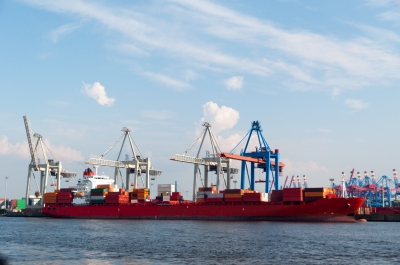
For ports and terminals to be selected for the P3 network, the main criterion will be the ability to handle ULCVs efficiently, with little margin for error, said Drewry. Quays will have to be long and deep, and each terminal will have to be equipped with cranes capable of spanning around 21 to 22 rows across deck. Moreover, a minimum of three to five of these are required for the efficient handling of the large box ships.
Photo: Je. T.