
 Ocean freight rates continued their decline last week, falling US$$171 to $469 per twenty-foot equivalent unit (TEU) on the Asia-Northwest Europe trade lane, according to Freight Investor Services (FIS).
As expected over the past few weeks carriers have announced their plans to prop up rates come September 1, with all major carriers insisting on a general rate increase (GRI) of around $1,000 per TEU, FIS said in a new analysis.
For instance, Hapag-Lloyd in early August said that by September 1, it will increase TEU rates for all cargoes and all container types on the Far East westbound trade by that amount.
“Initial expectations are that they may be at least partially successful, although as we have witnessed during August such increases are not likely to hold for any meaningful length of time,” FIS predicts.
It pointed out that the average weekly rate decline has increased significantly over the past few years. Year-to-date the average weekly decline stands at $107 per TEU, while for the same period last year this figure stood at $83 TEU. During 2013 this number was even lower at $65 a TEU.
“This points to the fact that the declines on average are actually accelerating, leading to increased volatility and a greater need for carriers to implement ever larger GRI’s,” it added.
These significant rate declines can be explained by the latest figures from Alphaliner, which suggest that demand on Asia-North Europe declined 3.5% during the first half of the year, while capacity actually increased 3.4%.
“In addition it’s therefore not unrealistic to expect further difficulties for carriers when trying to implement GRI’s in what has become a monthly ritual and that any such increases will be met with swift and rapid declines,” it said.
Last week shipping giant Maersk announced a 7.3% drop in profits, year on year, with the company blaming the loss on the lower freight rates on the Asia-Europe trade flow.
In a statement, the company said: “We expect the market to remain weak. We expect—with continued over-capacity—the rates to remain under pressure. We expect global container demand in 2015 to grow by 2-4% against a previous expectation of 3-5%.”
The Port of Hamburg last week also announced that seaborne cargo was down 6.8% from the first half of 2015. Overall, container shipping from Asia to Europe was down 20%–indicative of the wider trend in global trade and exports.
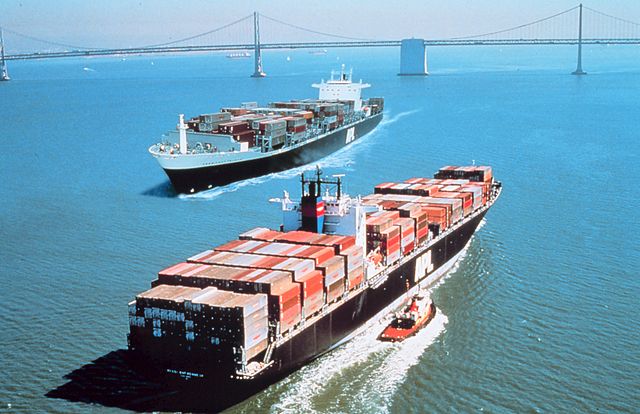
Photo: NOAA