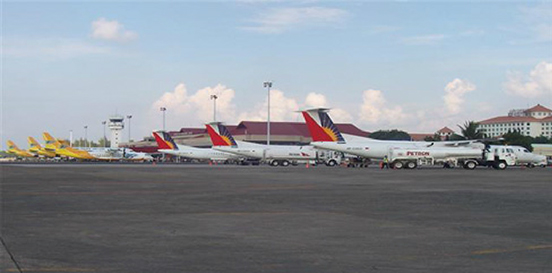
 Cargo volume in the Philippines’ second major gateway Mactan-Cebu International Airport (MCIA) rose 56.5% in 2015, with both domestic and international shipments recording double-digit improvements, latest data from the Mactan-Cebu International Airport Authority showed.
MCIA handled 84.732 million kilograms of air cargo in 2015, higher than the 54.130 million kg serviced in 2014.
Of the total, 77% were domestic cargoes with 84.732 million kg lifted, up 67% from 39.082 million kg in the previous year.
Foreign cargoes accounted for 23% of the aggregate, or 19.353 million kg. This is 28.6% more than 2014’s volume of 15.049 million kg.
Flights likewise improved 10.5% to 62,213 last year from 56,281 the preceding year. Domestic flights, which represented 79% of the total, grew 9.4% to 48,850 from 44,651. International flights were also up 15% to 13,363 from 11,630.
More passengers likewise used the Cebu gateway in 2015 with 7.781 million people recorded, 13.7% higher than the 6.84 million passengers in 2014.
Think tank Centre for Aviation (CAPA) earlier said the Cebu hub has “emerged as one of the fastest-growing airports in Southeast Asia” and “is poised for more rapid growth in 2016.”
“Mactan-Cebu is well positioned for long-term growth as the airport’s new private owners have begun construction of a new terminal, which will increase annual capacity to 12.5 million annual passengers,” CAPA said.
It added that the new terminal will enable Cebu to build itself as a hub for transit traffic, even as the airport is set to benefit further from infrastructure constraints in Manila that are prompting Philippine carriers to base additional aircraft in secondary cities.
Furthermore, the think tank said Cebu is a growing market in its own right—showing strength in both the inbound and outbound sectors—“but ultimately Cebu’s growth is enabled by the constraints at Manila and by its own expansion.”
Cebu is now operating above its designed capacity of 4.5 million annual passengers, but unlike Manila, it has the space and the commitment to expand, CAPA noted.
MCIA was taken over in late 2014 by GMR-Megawide, which won the 25-year concession to manage and expand the hub.
New international flights will be available this March that are seen to draw inbound tourism and give strong support to export services. These new flights are flag carrier Philippine Airlines’ Cebu-Los Angeles, EVA Air’s Cebu-Taipei, XiamenAir’s Cebu-Xiamen, and Emirates’ Cebu-Dubai operations. — Roumina Pablo