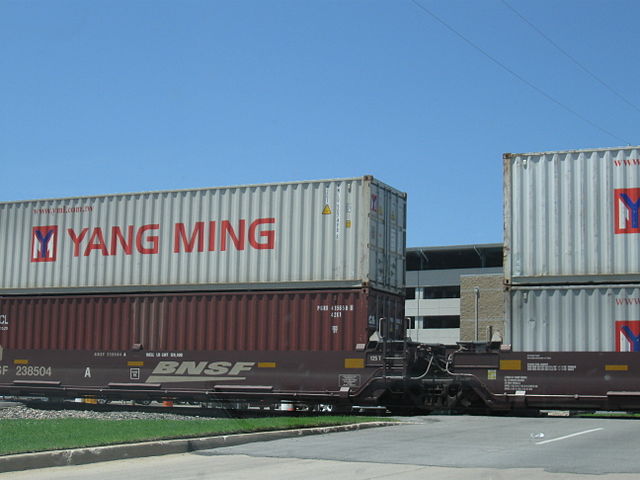
 Taiwanese ocean carrier Yang Ming Marine Transport Corporation reported an expanded net loss in the second quarter of 2018 despite slightly higher revenues and a double-digit rise in volumes, the bigger loss a result of higher fuel prices.
Net loss for the period was TWD3.81 billion (US$129.1 million) compared to a net loss of TWD445 million reported in the second quarter of 2017, said an official release from the shipping line. The company’s net loss for the second quarter of the year is also bigger than its net loss in the first quarter of 2018 amounting to TWD1.95 billion.
Consolidated revenues in the second quarter of this year reached TWD33.6 billion, up 1.12% from the same period in the previous year. The business volume of 1.29 million twenty-foot equivalent units (TEUs) rose 11.84% year-on-year.
Meantime, for the first half of 2018, Yang Ming’s net loss was TWD5.76 billion, higher than the net loss of TWD1.34 billion seen in the same period last year.
Consolidated revenues in the first semester totaled TWD64.6 billion, up 1.81% compared with the same period in the previous year. The first half of 2018 saw business volume total 2.52 million TEUs, climbing 10.28% from the same period in the previous year.
Unexpected higher fuel prices drove operating costs up in the first half of 2018, explained Yang Ming. “Compared with the same period last year, the average fuel price in the first half year increased about 25%. Additionally, the shipping industry still shows an oversupply in tonnage, and faces arduous and continued challenges this year.”
“However, since demand is expected to grow at 4.2% and with supply growth predicted at 3.7% in 2019, the economic forecast will be more optimistic, with the shipping industry to benefit,” said the carrier.
Efforts to lower costs and increase revenue continue, it said. Yang Ming vessels are taking advantage of slow steaming to reduce bunker consumption and harmful emissions. Also, it will be redelivering seven high-cost chartered vessels starting in the fourth quarter this year.
It said its second-half performance is expected to improve due to stronger peak season demand and less new tonnage being introduced to the market. “With these circumstances, ocean freight rates may rise as a result,” Yang Ming said.
Meanwhile, the demand/supply ratio is predicted to stabilize in the near future with service rationalization plans from the major alliances, and “we anticipate seeing an immediate improvement to our operating performance as a result,” it continued.
Planning for the future, Yang Ming has approved the construction of ten 2,800-TEU container ships equipped with advanced eco-friendly equipment which will comply with environmental regulations. These vessels will be deployed in the intra-Asia market.
In addition, five 14,000-TEU chartered vessels are scheduled for delivery beginning in the fourth quarter of 2018 and ten 12,000-TEU chartered vessels will be delivered in 2020 and 2021 to “help optimize our fleet in the anticipated improving market,” said the box liner.
Photo: Claire Powers