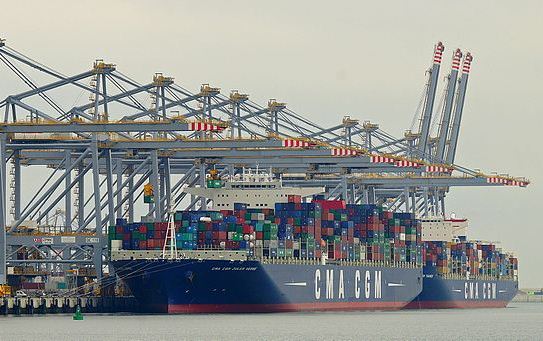

 French ocean carrier CMA CGM announced it will implement a low sulfur surcharge (LSS) to offset the higher cost of using compliant fuels in order to meet the International Maritime Organization’s (IMO) mandatory sulfur cap rule.
“The new IMO 2020 Low Sulphur Regulation impacts the global shipping industry and shipping costs are set to increase worldwide. As the cost of the Very Low Sulphur Fuel Oil (VLSFO) is expected to be significantly higher than the present High Sulphur Fuel Oil (HSFO), CMA CGM will implement a new price reference for its short-term and long-term contracts,” the company said in a statement.
From January 1, 2020, the new IMO 2020 low sulfur regulation will be in effect. All sea-going vessels worldwide will have to comply and reduce their sulfur emissions by 85%.
To comply with the regulation, sulfur in fuel oil must be reduced from 3.50% to 0.50%, in addition to the 0.10% sulfur limit already effective in the Emission Control Areas. This aims to reduce the amount of sulfur oxide emissions and should have major health and environmental benefits globally, including improving air quality and reducing risks of acidification of the oceans.
CMA CGM group said it will be compliant with a mix of three solutions: using liquid natural gas-powered vessels, using advanced air quality systems onboard its vessels, and as the main solution, using compliant fuels with 0.50% or 0.10% sulfur.
For short-term contracts of validity three months or shorter, a new monthly LSS will be applied on top of CMA CGM’s ocean freight charges, effective December 1, 2019.
“The LSS will be published on November 1st, 2019, and applicable as of December 1st, 2019,” said the carrier.
For long-term contracts of more than three months’ validity, VLSFO will replace HSFO as the price reference for the quarterly Bunker Adjustment Factor (BAF), effective January 1, 2020.
The BAF is applied on top of the ocean freight charges and will still be revised on a quarterly basis with a one-month notice. Note that the BAF quantum for reefer cargo will be 20% higher than that of dry cargo for the same container size, with a minimum of US$25 per TEU.
“The average VLSFO 0.5% price from September to November will be used as a reference for the BAF, published on December 1st, 2019, and applicable as of January 1st, 2020.”
Photo by kees torn