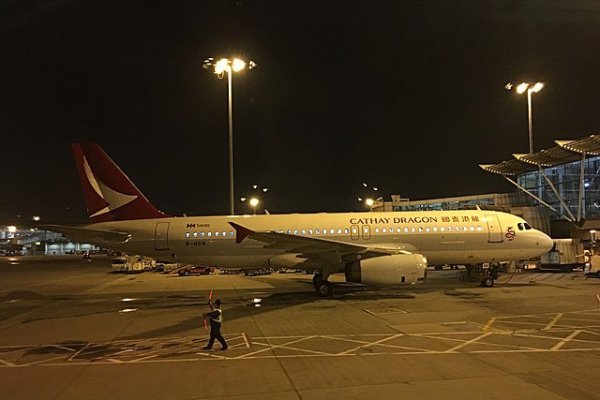

 The impact of political tensions between Hong Kong and China is reflected in Cathay Pacific group’s September traffic data which show decreases in both passenger and cargo volumes compared to the same month in 2018, according to Cathay Pacific group.
Cathay Pacific and Cathay Dragon carried a total of 2,426,961 passengers last month—a drop of 7.1% compared to September 2018. Passenger load factor decreased by 7.2 percentage points to 73.6%, while capacity rose by 9.8%.
In the first nine months of 2019, the number of passengers carried grew by 1.3% and capacity increased by 6.9%, as compared to the same period for 2018.
The two airlines carried 172,637 tonnes of cargo and mail last month, a drop of 4.4% compared to the same month last year. The cargo and mail load factor fell by 3.7 percentage points to 65.5%. Capacity was up by 0.1% while cargo and mail revenue freight tonne kilometers (RFTKs) dropped by 5.3%.
In the first nine months of 2019, the tonnage fell by 6.8% against a 0.7% increase in capacity and a 7.0% decrease in RFTKs, as compared to the same period for 2018.
“September was another challenging month for our passenger business, with revenue adversely affected by weakened market sentiment, particularly for travel into Hong Kong,” Cathay Pacific group chief customer and commercial officer Ronald Lam said.
Passenger load factor was down 7.2 percentage points and inbound passenger traffic dropped by 38%—both unchanged from August. Outbound traffic was down 9% year-on-year, a slight improvement over the 12% drop seen last month. Transit traffic via Hong Kong remained relatively stable.
“The mainland China market has been hit especially hard and we observed very weak demand for travel over the National Day holiday—traditionally a very strong period,” said Lam. “Our India routes were the main bright spot, buoyed by strong demand between India and North America.”
Intense competition together with an increasing reliance on transit passengers over the short term has continued to apply additional pressure on yield.
“We continue to see a significant shortfall in inbound bookings for the remainder of 2019 as compared to the same snapshot last year. This has been felt most strongly with bookings from mainland China and our other Asian markets,” said Lam.
As previously announced, the company is taking a number of short-term tactical measures to respond to this shortfall, most notably realigning capacity for the winter season (from end-October 2019 to end-March 2020).
For the cargo business, volumes improved compared to August as “we stepped into air freight’s traditional high-demand season,” said Lam. “Most markets saw a better month-on-month performance and we mounted a number of charter operations on top of our scheduled services to meet added demand for air freight coinciding with the release of new electronic products.”
However, he said the overall market remains challenging and competitive with tonnage carried and load factor for the year-to-date still significantly below the same period last year.
Photo by Edward Russell