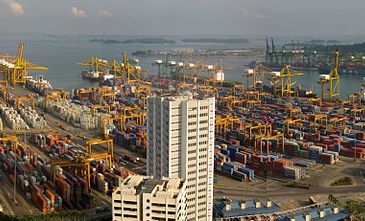
 The Port of Singapore maintained its vibrant growth as one of the world’s busiest ports in 2014, according to Transport Minister Lui Tuck Yew.
Annual vessel arrival tonnage reached a high of 2.37 billion gross tonnes (GT) in 2014, a 1.9% increase over 2013. It is also the highest in the 2010-2014 period, according to a press release by the Maritime and Port Authority of Singapore (MPA).
Container ships and tankers were the top contributors, each accounting for around 30% of total vessel arrival tonnage.
Total cargo tonnage handled last year also rose 3.5% from 2013 to 580.8 million tonnes, said Lui, citing advance estimates.
Overall container throughput was pegged at 33.9 million TEUs (twenty-foot equivalent units), 4% higher than the 32.6 million TEUs registered in 2013.
This however still puts it behind China’s Shanghai port, the world’s busiest container port for the fifth consecutive year with a 2014 throughput of 35.29 million TEUs.
Singapore also remained the world’s top bunkering port last year, as total volume of bunkers sold at the port reached 42.4 million tonnes, a slight dip compared to 42.7 million tonnes in 2013.
The total tonnage of ships under MPA’s register also grew by 11.7% year-on-year, or 8.6 million GT, to 82.2 million GT, to firm up Singapore’s ranking as one of the top 10 ship registries in the world.
Singapore is home to more than 130 international shipping groups and a total of 5,000 maritime establishments. The maritime cluster employs more than 170,000 people and contributes about 7% to Singapore’s GDP, MPA stated.
Looking forward, Lui said the government will continue to ensure that the maritime industry stays a key catalyst of economic growth, as the city-state makes further heavy investments in port infrastructure development.
He said work on Phase 3 and 4 of Pasir Panjang Terminal is progressing well, while the first two berths at PPT 3 started operations from the middle of 2014.
In addition, reclamation works at Tuas will be underway this year, and MPA will continue to work on testing new technologies for the port terminal.
Lui expressed cautious optimism for 2015, noting that sliding prices of oil will afford shipping companies some cost relief.
Photo: Kroisenbrunner