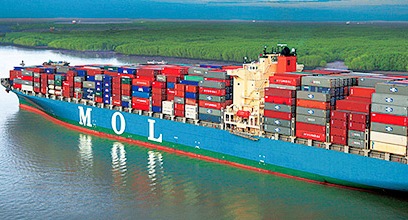

 Japanese ocean carrier Mitsui O.S.K. Lines (MOL) announced it expects to book a loss for its fiscal year 2015, a reversal of its earlier forecast of a profit as it sustained large restructuring costs in a challenging market and weak demand tied to China’s cooling economy.
The company in a statement said it predicts a consolidated net loss of JPY175 billion (US$1.45 billion) compared to its previous projected profit of JPY17 billion as it anticipates registering up to JPY180 billion in extraordinary loss from retirement of vessels and restructuring costs.
The company made the downward revision to its full-year forecast for the fiscal year 2015 (April 1, 2015 to March 31, 2016) that it issued on October 30, 2015 for operating income and ordinary income “in consideration of a significantly weaker than anticipated (in the) dry bulker market despite the tailwind of lower bunker prices, as well as a delay in recovery of containership freight rates.”
In the new prediction, the earlier operating income of JPY5 billion has been changed to a loss of JPY5 billion, while ordinary income is slashed to JPY32 billion from JPY42 billion.
In the dry bulker business, MOL said the market is “deteriorating to a new record low due to the imbalance of fleet supply and demand, along with stagnant cargo trade resulting from the slowdown in China’s economy since last fall.”
On the container ship business, “cargo volume, mainly for Europe and emerging countries, hovered at low levels while a succession of newbuilding vessels came into service, keeping freight rates at historic lows.”
“The company has decided to implement business structural reforms in response to the current severe business environment, and details of each measure are under consideration,” said the statement.
For its dry bulker segment, there will be a further reduction in the number of free Capesize vessels, while withdrawing from offering excess tonnage in the free-vessel market for Panamax and other mid- and small-size bulkers.
For the container ship business, the company will reinforce its business structure and boost the bottom line by striving to capture more profitable cargoes, reduce fixed costs through rationalization mainly on North-South routes, and cut down the fleet of mid-size vessels.
Finally, MOL intends to overhaul its current midterm management plan “Steer for 2020” which was slated to continue through fiscal year 2016, and unveil a new one for the new fiscal year.