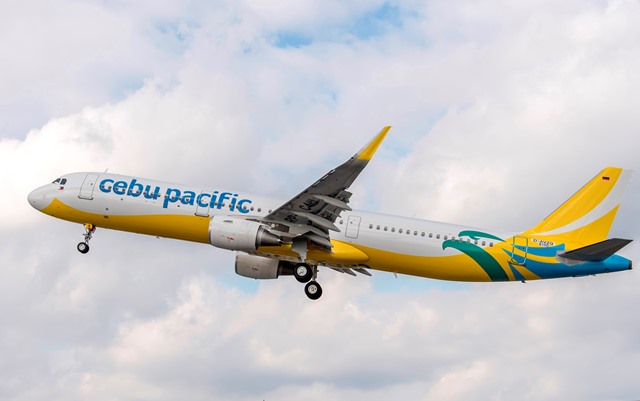

 Cebu Pacific and its sister companies posted a 23.6% decline in net income for the first six months of 2018 as operating expenses grew 14% due to rising fuel prices and a weak peso.
Parent company Cebu Air, Inc. disclosed that net income of the group in the first half of 2018 reached P3.309 billion, lower than the P4.334 billion net income earned in the same period last year. The group includes Cebu Pacific, Cebgo, and 1Aviation Groundhandling Services Corp.
Group revenues amounted to P37.835 billion for the first half of 2018, which is 6.1% higher than the P35.656 billion in revenues generated in the same period last year.
Passenger revenues went up 6.3% to P28.303 billion from P26.620 billion, mainly due to the 3.7% increase in average fares. The growth in passenger volume by 2.6% to 10.354 million from 10.094 million last year also bolstered revenues.
Cargo revenues likewise grew 28.1% to P2.652 billion from P2.071 billion following the increase in the volume of cargo transported in 2018.
Ancillary revenues, on the other hand, declined 1.2% to P6.879 billion from P6.965 billion consequent to the decline in average ancillary revenue per passenger, mainly due to the lower baggage volume and pre-ordered meals in line with the suspension of Middle East operations in 2017.
The group incurred operating expenses of P33.060 billion for the initial six months of the year, 14% higher than the P29.004 billion in operating expenses reported in the same period last year. The increase was mostly attributable to the rise in fuel prices in 2018, coupled with the depreciation of the Philippine peso against the U.S. dollar. The growth in the airline’s seat capacity after it acquired new aircraft also raised expenses.
Earlier, Cebu Pacific chief executive officer Lance Gokongwei said that “the effect of the fuel price and currency has been quite significant for us.”
“The effect of fuel, approximately P20 million per month for every dollar increase, and the effect of currency is about P65 million per month because of the weaker peso,” he said.
Cebu Pacific and sister airline Cebgo have already submitted petitions with the Civil Aeronautics Board to levy fuel surcharge on domestic and international flights.
As of June 30, 2018, the group operates an extensive route network serving 65 domestic routes and 36 international routes with a total of 2,618 scheduled weekly flights. It operates a fleet of 67 aircraft which is comprised of 36 Airbus A320, five Airbus A321 CEO, eight Airbus A330, eight ATR 72-500 aircraft, and 10 ATR 72-600. It operates its Airbus aircraft on both domestic and international routes and operates the ATR 72-500 and ATR 72-600 aircraft on domestic routes, including destinations with runway limitations.