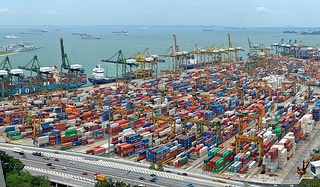
 The global container port industry carries a more optimistic outlook, but also faces higher risks, something that doesn’t deter Chinese players from their merger and acquisition (M&A) pursuits, according to a new report from Drewry.
In its “Global Container Terminal Operators Annual Report 2017,” Drewry presents a more positive forecast for container port demand compared to last year’s report. It foresees a 4% compound annual growth rate (CAGR) and adds a further 152 million TEUs of port throughput to the global total by 2021.
“This is a consequence of improved port throughput growth rates in the second half of 2016 and into 2017, and a more positive general global economic outlook,” said the global shipping consultancy.
However, numerous risks and uncertainties lie ahead, including tensions in the Middle East and Korean peninsula, the protectionist and unpredictable stance of the U.S. administration, and the impact of Brexit.
“This is perhaps one reason why the global container port capacity is projected to increase by a CAGR of 2.7%, based on confirmed additions only. This is markedly lower than the forecast demand, and hence, average utilization levels are expected to rise,” it said.
Neil Davidson, Drewry’s senior analyst for ports and terminals, said: “While there are certainly some encouraging signs for the demand growth outlook, the risk profile for terminal operators has increased and most of the traditional global/international players remain cautious. The exception to this are the Chinese port companies who are pursuing expansion and investment both at home and overseas in an unprecedentedly aggressive manner.”
The report further predicts that Chinese players will continue to tread the acquisition trail “in an aggressive and highly confident manner,” eventually leading to changes in the port sector landscape.
M&A activity in the port sector is at a high level, said Drewry. About US$3.1 billion worth of deals have been struck so far in 2017, driven by Chinese companies such as Cosco Shipping Ports and China Merchants Ports. In the last year, more than half of the acquisitions by global and international terminal operators have been made by Chinese players, who are typically prepared to pay a premium.
Cosco Shipping Ports has moved up Drewry’s operator league table as a result of the merger of Cosco and China Shipping, and will move further up in the coming years due to the acquisition of Noatum and OOCL’s terminals.
The China Cosco Shipping group is projected to add the most capacity of any of the global and international terminal operators over the next five years.
“The Chinese players are more comfortable with risk than the established international operators right now, and have a geo-political strategy rather than a purely financial one. They are snapping up assets and opportunities and have the appetite and financial clout to take many more in the coming years,” added Davidson.
Photo: JHH755