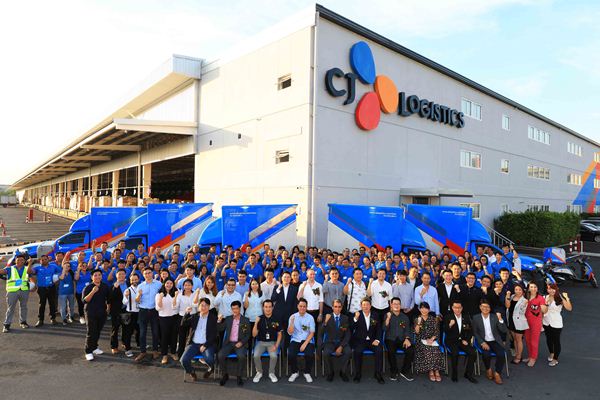
 South Korean-based CJ Logistics has launched a new parcel distribution center in Thailand with plans to invest a total of US$43 million in the facility by 2021 as part of its “Pan Asia No.1” strategy.
Located in Bangphli (Bangna), Samutprakarn, the 71,900-square-meter CJ Logistics Smart Hub Bangna offers parcel and logistics services with a maximum daily capacity of 408,000 units, aiming to respond to market trends and demands and to the rapid expansion of e-commerce in the country.
The latest smart hub supports the company’s plan to become one of the top global logistics companies through infrastructure investment and network development, especially in Southeast Asian markets like Thailand and Malaysia, the company said in a release.
The hub is also in support of “Thailand 4.0,” which is expected to significantly expand the consumer goods logistics market including the parcel industry.
To achieve these goals both locally and globally, CJ Logistics will invest a total of $43 million in Smart Hub Bangna by 2021, “which is in line with our ‘Pan Asia No.1’ strategy of building a logistics network across the Asian region,” said Tae-Young Chung, senior executive vice president-head of parcel business unit, CJ Logistics.
The hub is fully equipped with cutting-edge logistics technologies and platforms, including an automatic wheel sorter system and intelligent scanner.
“With the additional infrastructures by 2021, these will enhance efficiency by expanding capacity and allow for the sorting of up to maximum 408,000 parcel goods per day,” said Tae-Young.
Myeong-Guk Park, general director of parcel business, CJ Logistics Thailand, added: “Thailand’s e-commerce market is growing at a double-digit rate every year as the emerging of middle class with a strong purchasing power and the young generation actively embrace the mobile environment.
“CJ Logistics Thailand foresees the growth of the parcel business in the country and is therefore continuously expanding points of service, increasing driver numbers and our daily capacity to cover all regions.”
From 24 regional distribution centers, 320 drivers and a daily capacity of 10,000 parcels in 2016, he said the company will have 120 regional distribution centers, an additional 2,200 drivers and a maximum daily capacity of 240,000 parcels by next year.