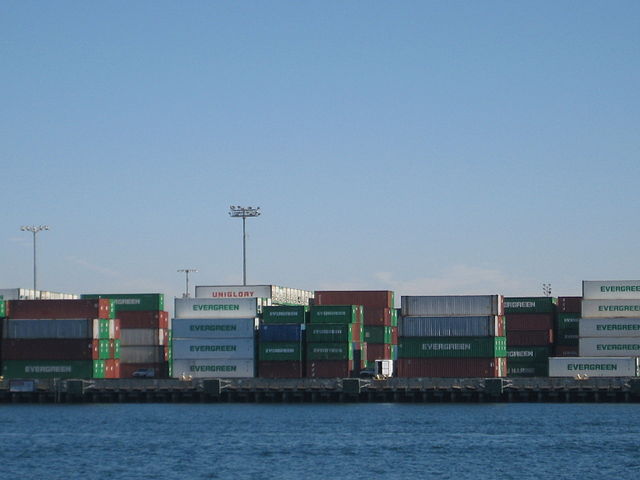
There is no congestion at Manila ports, Trade Secretary Ramon Lopez announced following his meeting with Customs commissioner Isidro Lapeña last week.
In a statement, the trade chief said Lapeña “clarified” perceptions of congestion, which are prompted by the “line of trucks” caused in turn by port operators’ policy of limiting entry of empty container vans.
“The space for empty containers is already fully utilized and allowing more may eat up the space for filled containers,” Lopez said.
“We need to clear this issue because perceived port congestion may cause companies to delay their shipments, and consequently… result in lower supply of goods and higher inflation.”
He noted the Bureau of Customs (BOC) is “already increasing capacity via inland container depots in Laguna and other areas to solve this issue. But rest assured that there is no delay in transporting shipments to and from the port.”
For the first three quarters of 2018, the metrics at Manila ports are “well within international standards”, according to Port of Manila District Collector Atty. Erastus Austria, who attended the meeting between Lopez and Lapeña.
In order to declare port congestion Austria, also the BOC spokesperson, said the import dwell time has to be 10 days or more.
From January to September, Manila ports’ import dwell time was 7 days, and yard utilization level at 85%. In addition, quay crane production rate was at 24.84 moves per hour against the international standard of 25.
At the height of the 2014 port congestion, crane productivity was at 15 moves per hour, the import dwell time 17-18 days, and port utilization was at 96%, Austria said.
At the meeting, BOC also expressed its commitment to prioritizing clearance of imported agriculture products, in keeping with President Rodrigo Duterte’s Administrative Order 13 which streamlines the importation of agricultural products to ease inflation.
Space shortage
Earlier, the president of the Container Depot Alliance of the Philippines (CDAP) said empty containers may soon have to be returned to off-dock depots outside Metro Manila as off-dock depots within the metro are fast filling up even before the peak season.
Utilization of off-dock depots in Metro Manila is already at 90% of capacity, CDAP president Roger Lalu told PortCalls. The average dwell time of empty containers has also doubled to 30 days from 15 days previously.
“Due to high utilization of container depots in Metro Manila and the slow-paced container evacuation of shipping lines, CDAP members who are all operating in Metro Manila may not be able to accommodate empty container return even before the peak season,” Lalu said.
“Sooner or later shipping lines will have no other option but to use depots outside Metro Manila,” he added.