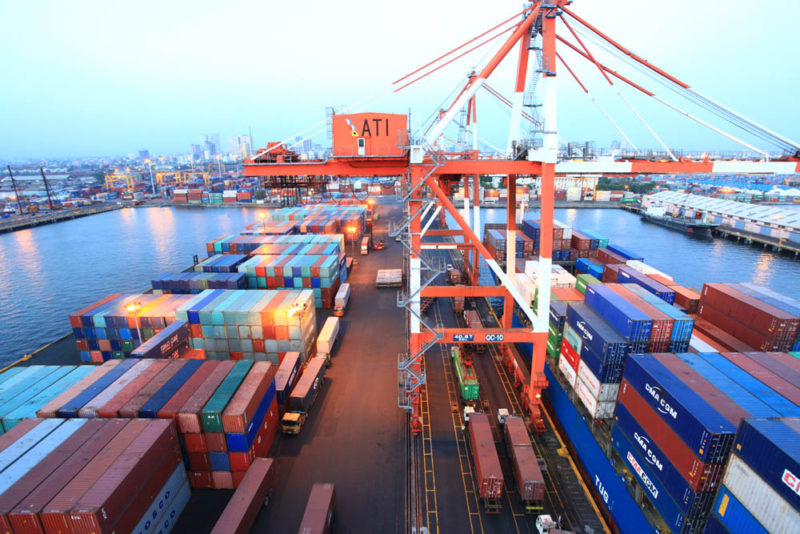

Despite the heavy cargo influx triggered by the holidays, Manila South Harbor has not shown signs of a slowdown in productivity going into December, according to port operator Asian Terminals Inc. (ATI).
As of the first week of the Christmas month, berth occupancy at South Harbor is below 60%, yard utilization is well within international standards at 70%, and there are no vessel queues at anchorage, ATI said in a statement.
All these indicate that the terminal has ample space for container storage and sufficient capacity to handle more vessels, precluding any delays in import shipments this peak season, the port operator added.
“It’s the best December we’ve ever had at South Harbor. Cargo flow has remained robust and unimpeded, even as we reach this year’s homestretch,” ATI executive vice president Andrew Hoad said.
With barely three weeks to go before the year ends, Manila South Harbor said 2016 is quickly turning out to be its best operational year yet, bannered by record-breaking volumes, highest terminal productivity, and fastest service delivery.
In September, the terminal handled over 100,000 twenty-foot equivalent units (TEUs) of international containers for the first time in a single month, besting its performance in May, June, and October when it handled over 90,000 TEUs.
Despite the volume spike, production at the port has averaged above the industry standard of 25 gross moves per crane per hour (GMPH), and even recorded world-class levels of over 30 GMPH for several months, comparable to the production at leading global ports in Dubai, Singapore, and Hong Kong.
ATI attributed its efficiency to modern machinery, yard capacity, and technology, which have continuously improved over the years in tandem with growing market demand.
These enhancements, it said, includes the Terminal Appointment Booking System, an online maritime scheduling system which allows for the orderly daily pull-out and delivery of containers at the port spread over 24 hours. This has quickened flow of goods and trucks in and out the terminal without causing heavy traffic on roads, the operator said.