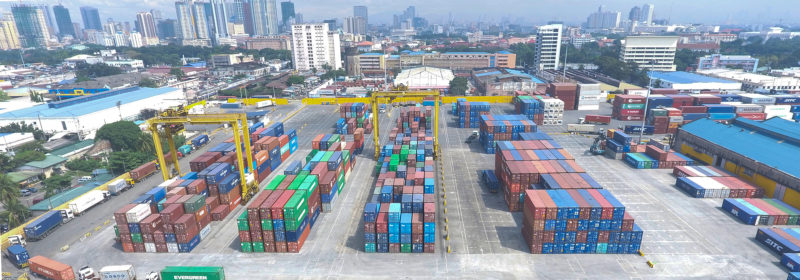


Around 5,000 twenty-foot equivalent units (TEUs) of static cargo space has been added at Manila South Harbor following completion of the expansion of Container Yard 2, according to port operator Asian Terminals Inc. (ATI).
The new space has a total of five blocks for rubber-tired gantry (RTG) operations, ATI said in a statement.
A further capacity of 10,000 TEUs is expected to be delivered from 2020 to 2021 with the ongoing expansion of Manila South Harbor’s main yard and the scheduled extension of its berthing facilities at Pier 3.
ATI said that with the expansion in Manila South Harbor and its terminal in Batangas early this year, it does not expect to encounter any cargo flow bottlenecks during the holiday season.
Last April, Batangas Container Terminal (BCT) effectively doubled its annual capacity to around 500,000 TEUs when it deployed two more quay cranes and four additional RTGs, and expanded its berthing and yard facilities.
ATI said that all these investments, which it has committed to the Philippine Ports Authority, will sustain efficient terminal operations that will benefit its shipping line customers and beneficial cargo owners.
ATI is also building a new passenger terminal in Batangas, expected to be operational by 2021. It has also opened a new five-hectare empty container depot in Calamba, Laguna that can cater to the needs of both Batangas and Manila ports. Last year, it inaugurated its new multilevel car storage facility, which increased Batangas port’s capacity, enabling it to handle 5,400 completely built vehicles.
Meanwhile, ATI reported a net income of P2.85 billion in the first nine months of 2019, which is 30.2% higher than the P2.19 billion recorded in the same period last year, the increase attributable to continued growth in international cargoes at its terminals in Manila and Batangas.
In a regulatory disclosure, ATI said its revenues for the first nine months reached P10.17 billion, up by 14.8% from P8.85 billion in the same period last year on account of the double-digit cargo volume growth handled by both marine terminals.
From January to September, Manila South Harbor handled a record volume of over 960,000 TEUs, higher by 12.3% compared to last year.
BCT, on the other hand, already equalled as of September 2019 its full-year 2018 volume, as it facilitated the delivery of nearly 250,000 TEUs for the nine-month period, representing a 38.7% growth from the same year-ago period.