 Orient Overseas Container Line (OOCL) announced it booked higher volumes and revenues for the second quarter and first half of 2019 compared to the same periods last year. The trans-Atlantic trade lane mustered double-digit growth in both traffic and revenue for these periods, while the trans-Pacific loop contracted in volume in both second quarter and first half of the year, but posted revenue growth.
In a statement, OOCL said total volumes in the second quarter of 2019 ended June 30, 2019 were higher by 4.6% to 1.769 million twenty foot equivalent units (TEUs) from the 1.692 million TEUs recorded in the same period last year.
In the second quarter of 2019, total revenues increased by 7.1% to US$1.566 billion from $1.462 billion in the second quarter of 2018. Loadable capacity increased by 6.4%. The overall load factor was 1.4% lower than the same period in 2018. Overall average revenue per TEU increased by 2.4% compared to the second quarter of last year.
By trade lane, save for the trans-Pacific lane where volumes fell 0.6% in the second quarter of 2019 year-on-year, all other lanes posted growth. The trans-Atlantic trade lane grew 16.3% to 123,472 TEUs. Asia-Europe volumes rose 9.4% to 366,575 TEUs, while the Intra-Asia/Australasia loop posted growth of 4.3% year-on-year to 776,294 TEUs.
In terms of revenue for the second quarter of this year, the trans-Atlantic trade lane recorded a 23.9% growth to $154.264 million compared to the same period last year. Intra-Asia/Australasia logged a 7.5% expansion to $481.582 million, while the trans-Pacific saw revenue growth of 6.0% to $622.261 million. Lastly, Asia-Europe posted growth of 1.9% to $308.327 million.
Meanwhile, for the first six months of 2019, OOCL’s total volumes increased by 3.2% to 3.374 million TEUs from 3.271 million TEUs in the same period last year.
Total revenues in the first half recorded a 6.5% growth to $3.027 billion from the previous $2.841 billion. Loadable capacity increased by 4.3%. The overall load factor was 0.9% lower than the same period in 2018. Overall average revenue per TEU increased by 3.3% compared to the same period last year.
By trade lane, trans-Atlantic liftings reached 240,294 TEUs, up 14.9% from the first six months last year. This was followed by Asia-Europe with 691,815 TEUs, up 8.5%, then Intra-Asia/Australasia with 1.499 million TEUs for a growth of 2.6%. Meanwhile the trans-Pacific volume contracted 2.0% to 943,691 TEUs compared to the first half of 2018.
Revenue in the first six months for the trans-Atlantic loop went up 20.1% to $294.859 million, followed by the trans-Pacific, which recorded a 5.8% revenue growth to $1.181 billion. Asia-Europe saw growth of 5.0% to $613.236 million while Intra-Asia/Australasia had a 4.7% growth to $937.690 million.
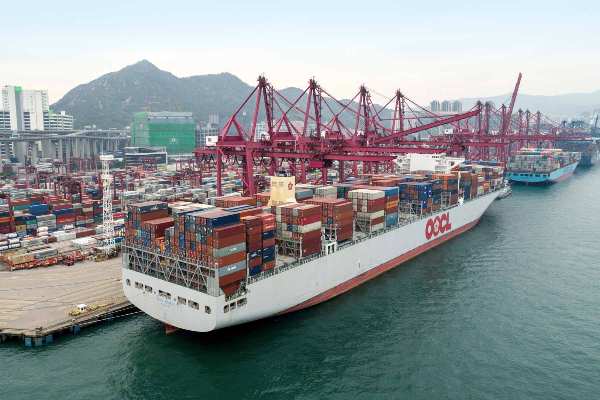
Photo courtesy of OOCL