The Philippine Ports Authority (PPA) reported steady growth in cargo volume in the first two months of the year, with containerized throughput rising 1.91% to 822,029 twenty-foot equivalent units (TEUs) from 806,662 TEUs in the same months last year.
For January to February, both containerized and non-containerized cargo volume rose 7.67% to 27.3 million metric tons (mmt) compared with 25.36 mmt year-on-year.
Manila International Container Terminal (MICT) remained the country’s main international gateway, accounting for 11.39% or 3.11 mmt of the total cargo volume. MICT handled the largest volume of foreign containerized cargo at 277,203 TEUs, followed by Manila South Harbor with 143,339 TEUs.
The biggest volume of domestic containerized cargo at 138,054 TEUs was handled by North Harbor port.
PPA general manager Juan Sta. Ana attributed the cargo volume growth to expansion in the local economy that spurred product shipments and movement of people.
In particular, Sta. Ana cited the significant rise in cargo volume handled in 19 port management offices (PMOs) with Iligan recording the highest increase at 103.25%, on the back of mineral ore shipments by Semirara Corp. The PMO of San Fernando came in second with a 55.35% increase because of higher sand exports.
Foreign cargo transshipped in the Philippines jumped 12.12% to 15.04 mmt from 13.41 mmt while domestic cargo that moved within the country inched up 2.7% to 12.26 mmt from 11.94 mmt.
Sta Ana said the increase in 19 PMOs was enough to offset the decline in five PMOs, including the 36.4% throughput drop in Manila South Harbor followed by the 18.4% slide in Surigao and the 7.21% contraction in Iloilo.
Sta. Ana said the performance of South Harbor was dragged down by a big drop in domestic cargo volume handled at Pasig as well as the drop in import volume at the base port.
He also blamed the decline in Surigao’s port performance to lower exports of nickel at the private ports of Taganito and Hinatuan.
Meanwhile, passenger traffic in the first two months of the year rose 3.6%. The domestic passenger volume reached 7.89 million or 272,882 more than the 7.62 million last year.
“The numbers still reflect the impact of competition posed by airlines offering budget fares,” Sta Ana said.
The agency notes a continuing shift of domestic sea travelers to air transport amid the fare war among low-cost carriers.
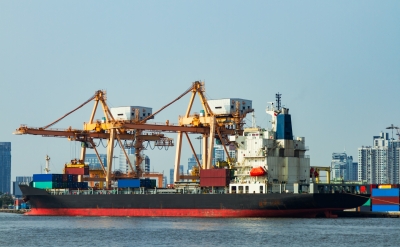
Photo courtesy of International Container Terminal Services, Inc