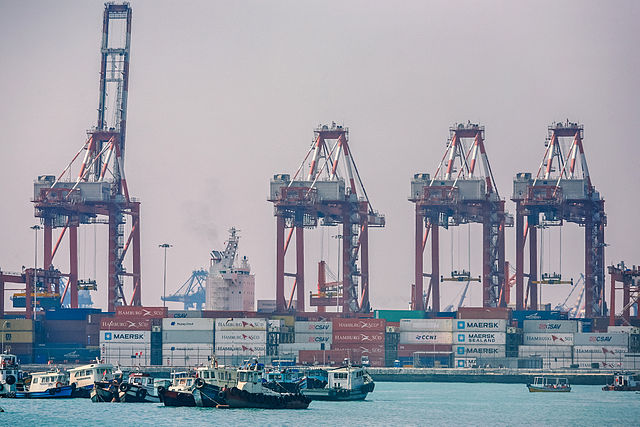

Cargo volume handled by Philippine ports jumped 11% in the first seven months of the year to 141.770 million metric tons (mmt) from 128.217 mmt registered in the same period last year, according to the Philippine Ports Authority (PPA).
Of the total, foreign cargoes accounted for 86.302 mmt, a 12% increase. Domestic traffic recorded a 9% growth for the period.
“The strong performance of the cargo segment underscores the country’s economic resilience,” PPA general manager Jay Daniel Santiago said in a statement.
Santiago said that the ports of Agusan, Mindoro, Panay/Guimaras, National Capital Region North, and Negros Oriental/Siquijor posted the biggest growth percentage in local and foreign cargo, while North Harbor remained the top performer in domestic cargo volume.
Containerized cargo traffic rose 9% for the period in review to 3.676 million twenty-foot equivalent units (TEUs) from 3.368 million TEUs last year, wherein both foreign and domestic boxes registered a 9% hike to 2.203 million TEUs and 1.473 million TEUs, respectively.
The Manila International Container Terminal remains as the country’s top handler of foreign boxes, processing 1.241 million TEUs during the period, followed by the Manila South Harbor which handled 584,598 TEUs. As expected, North Harbor took the lead in terms of domestic boxes handled with 696,495 TEUs.
Ship calls also went up by 9%, from 234,468 in 2015 to 255,037 this year. Domestic and foreign ship calls grew by 8.45% and 21.91%, respectively.
Passenger volume jumped 11% to 42.492 million from 38.213 million in the first seven months of 2015. Foreign passengers dominated the increase in traffic after posting a 69% increase to 71,514 passengers, while domestic passenger volume booked an 11% hike to 42.420 million passengers.
“The strong numbers in the passage sector also suggests the continuing vibrancy of both the local and international travel industries and more people are now considering traveling using ships,” Santiago said.
“Despite the surging numbers, we guarantee that our ports remain clog-free and can accommodate the increasing cargo, passenger and shipcall volumes.”
At present, the combined yard utilization of the two Manila international ports is at 40%, or about 32,600 TEUs are inside the terminals, while yard productivity remains high, ranging from 20 moves to 30 moves an hour, the PPA chief said.
The “efficient yard management for both terminals is attributed partly to the truck Terminal Appointment Booking System (TABS) that catapulted port efficiency by at least 96%,” Santiago added.
Prior to TABS, he said the average daily gate-out at the two Manila ports was at 4,500 to 5,000 TEUs compared with post-TABS daily gate-out of 7,000 to 7,500 TEUs.
“With this kind of yard utilization, we can say that Philippine ports are ready to handle the expected increase in the volume of cargo due to the run-up to Christmas,” Santiago said.