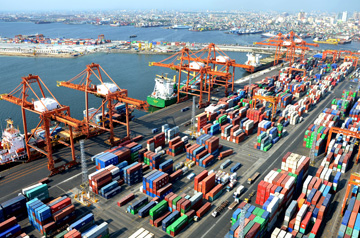
 The United Nations Conference on Trade and Development (UNCTAD) says ports are not ready to cope with the projected impacts of climate change, a situation that has import on the trade and sustainable development goals of all nations.
UNCTAD’s chief of policy and legislation, Regina Asariotis, said at the recent COP24 global climate summit that with about 80% of world trade carried by sea, the maritime industry will bear the brunt of climate change the most, unless it adapts fast.
“The hardest hit areas, coastlines, will affect us all since the lion’s share of trade itself is managed through international shipping and ports,” said Asariotis.
This is a fact that all actors in the ocean economy must face as it has bearing on the trade and sustainable development prospects of all countries, but particularly developing and vulnerable small island nations, she added.
Indeed 60% of goods loaded and 63% of goods are unloaded in developing countries, UNCTAD has found.
Asariotis explained the double-edged nature of the climate challenge facing both the maritime and whole transport sector.
On one side, she said, maritime transport impacts the environment, through pollution and CO2 emissions.
On the other, rising sea levels and extreme weather—such as storms, record temperatures, heat waves, droughts, and devastating rain—will affect maritime transport and infrastructure in major ways.
This is anticipated as early as 2030, when the 1.5ºC global warming point is likely to be reached.
There is urgent need to prepare ports and coastal transport infrastructure if the world trade system is to cope with the projected impacts of climate change, including damage, delay, and disruption across closely linked global supply chains, said Asariotis.
“The impacts may be severe, and given what is at stake, we have no time to lose,” said Asariotis.
“Currently there is a disconnect between the evidence from the scientific community and the pace of policy change made by governments.”
She noted how there is little over a decade left to keep global warming below the 1.5ºC threshold as set out in the Paris Agreement on climate change and informed by the 2030 Agenda on Sustainable Development.
In maritime transport, the call for mitigation, or the reduction and control of greenhouse gas emissions, while important, particularly in the long term, is not sufficient, now that the impacts of climate variability and change are happening already, Asariotis added.
“What is needed are effective adaptation measures and policies, implemented now to manage the direct and indirect impacts on maritime transport infrastructure and services.”
“Changes in sea-level, temperature, humidity, precipitation and extreme storms, floods and other climatic factors are likely to affect seaports as well as all connecting transport infrastructure and the global network of supply-chains. Understanding the impacts and developing effective adaptation measures is critical,” Asariotis elaborated.
Results of a recent global port industry survey on climate change impacts and adaptation carried out by UNCTAD suggest, however, that much more needs to be done.
Although most respondent ports—which collectively handle over 16% of global throughput—had been impacted by weather-related events, the survey revealed important gaps in information available to seaports of all sizes and across regions, with implications for effective climate risk assessment and adaptation planning.
“There is a need for better data and information and for mainstreaming climate change considerations into ordinary planning and operations processes,” she said.
Photo: Mukund (Maku)