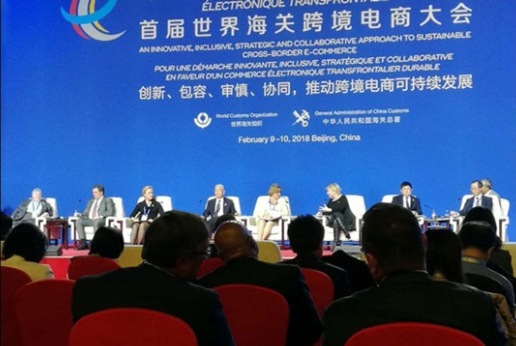
 The First Global Cross-Border E-Commerce Conference, co-hosted by the World Customs Organization (WCO) and the General Administration of China Customs (GACC), has recognized the immense opportunities that e-commerce brings but also calls for digital transparency and deeper cooperation to address the current and emerging challenges it presents.
The conference, held February 9 and 10 in Beijing, brought together nearly 2,000 representatives from customs administrations, other government agencies, e-commerce operators, international organizations, micro, small and medium-sized enterprises (MSMEs), consumers, and academia from various countries and regions.
The participants in their Beijing Declaration “recognized the huge opportunity to boost economic competitiveness, provide new growth engines, develop new trade models, drive new consumption trends and create new job opportunities” through e-commerce. It also highlighted the relevance of cultivating transparent digital economy policy making.
The conference called on all stakeholders to support the balanced, transparent, non-discriminatory, and sustainable development of e-commerce, “in an inclusive, strategic, innovative and collaborative manner.”
It also saw the need to proactively address current and emerging challenges, particularly in the areas of revenue collection, protection of intellectual property rights, and the security and safety of citizens.
The conference emphasized the need for an international standard, and supported the expeditious development of the WCO Framework of Standards on Cross-Border E-Commerce, the first guiding document on how the world customs community and relevant border agencies can better regulate and facilitate cross-border e-commerce.
In addition, it called for establishing mechanisms for the exchange of advance electronic data with appropriate data privacy and security safeguards, enhancing connectivity to bridge the digital divide, building capacities and infrastructures, and promoting inclusivity.
The conference also underlined the increased importance of trade facilitation for cross-border e-commerce and of fully implementing the WTO Trade Facilitation Agreement to enhance the contribution e-commerce makes to lowering costs and increasing efficiency in international trade.
The conference encouraged taking effective measures, including collaboration between government agencies, e-commerce operators, and other stakeholders through platform interfacing, data sharing, expanding the scope of single windows to include all stakeholders, and exploring the use of new technologies to enhance data visibility and risk management.
The conference noted the significant role of modern information and communication technologies, especially those relating to mobile devices, in fueling cross-border e-commerce development.
It likewise called on all stakeholders to give their full attention to the revolutionary changes brought about by the integration of cross-border e-commerce with such technologies as the Internet of Things, artificial intelligence, block chain, big data, and cloud computing.
“The Conference has helped enhance consensus among all relevant parties on upgrading regulation principles, promoting trade security and facilitation and achieving balanced development of global cross-border e-commerce,” said GACC Minister Yu Guangzhou.
Dr. Kunio Mikuriya, WCO secretary general, stated that “the WCO is ready to deliver inclusive global standards and provide all necessary support to meet the expectations of all stakeholders towards further supporting cross-border e-commerce in a harmonized and efficient manner.”
It was suggested that the conference be held every two years in different regions.
Photo courtesy of WCO