
The Philippines has acceded to a UN treaty that aims to accelerate cross-border digital trade in the Asia-Pacific region, making it the first Southeast Asian nation to accede to the agreement.
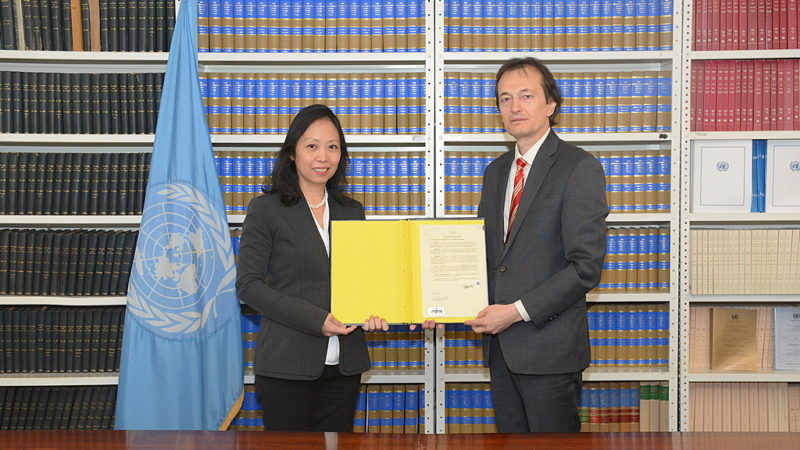
The Philippines acceded to the United Nations Economic and Social Commission for Asia and the Pacific (UNESCAP) Framework Agreement on Facilitation of Cross-border Paperless Trade in Asia and the Pacific on December 23 in New York. This makes the Philippines the first Association of Southeast Asian Nations (ASEAN) member country to accede to the treaty.
The framework agreement, a UN treaty deposited with the secretary general of the UN in New York, is aimed at accelerating the implementation of digital trade facilitation measures for trade and development. Designed as an inclusive instrument accessible to countries at all levels of development to develop their capacity to engage in cross-border paperless trade, the final treaty text was adopted by UNESCAP in May 2016.
It is expected to provide countries of Asia and the Pacific with a new tool and “digital” complement to better implement the World Trade Organization (WTO) Trade Facilitation Agreement (TFA) and the development of cross-border e-commerce.
Trade cost reductions expected from full implementation of cross-border paperless trade are estimated at 10% to 30% of existing transactions costs, depending on the current state of paperless trade development in the participating countries. Significant benefits in terms of trade compliance are also expected.
Based on the UNESCAP report titled “Digital and Sustainable Trade Facilitation in ASEAN,” implementation of cross-border paperless trade, together with the WTO TFA, is expected to help the Philippines cut trade costs by at least 10%, boosting its competitiveness. Trade cost savings could increase further should Philippines trade partners also join in the initiative.
Other benefits of the framework agreement include ready access to potential counterpart countries for negotiation on cross-border data exchange, thus avoiding numerous bilateral approaches and reducing the work involved in preparing bilateral or subregional arrangements and improving paperless trade readiness at national level.
It also provides the opportunity to make national paperless trade practices interoperable and become better prepared to engage in cross-border trade data exchange, in particular through structured and regular sharing of lessons.
Another benefit is direct participation in developing pragmatic solutions for the cross-border exchange of trade documents, which can increase the possibility of becoming early adopter/implementer, and thus, would potentially boost trade competitiveness.
The framework agreement can also reduce overall investment costs and trade transaction time, while improving levels of compliance by traders to regulatory requirements in international trade.
Other countries that have formally signed the framework agreement include Armenia, Bangladesh, Cambodia, China, and Iran, which all acceded in 2017, while Azerbaijan acceded in March 2018. The framework agreement is open to the 53 member states in Asia and the Pacific region. – Roumina Pablo