
 Vietnam is to build a special economic zone (SEZ) in Ho Chi Minh (HCM) City that is envisioned to spur the further socioeconomic development of the city, particularly its port and shipping industry.
The special economic zone will be built in the south of the city, covering District 7, Nha Be, and parts of Binh Chanh and Can Gio, according to a report by VietnamNet Bridge.
The special economic zone covers the Hiep Phuoc Port, Phu My Hung urban area, industrial parks and other new urban areas, according to Hoang Minh Tri, deputy head of HCM City Research and Development Institute.
The SEZ is part of a master zoning plan to develop HCM City until 2020 with a vision toward 2025. This plan envisages a system of satellite urban areas, industrial clusters, commercial areas, and special economic zones. Development is to be spread out in four directions—east, west, south and north—with focus on the seaports-heavy and logistics-intensive areas of the south and east.
The economy will be developed based on a service-industry-agriculture structure, with priority put on finance, insurance, trade, transport, warehousing, port services, postal and telecommunications, information technology, communications, and real estate.
The city reportedly needs an investment of about US$470 billion in the next decade to implement the plan.
Seaport development is also being undertaken to facilitate trade between HCM and its neighboring provinces. Among the enhancement programs are the completion of the second phase of the Soai Rap dredging project and the planned development of the seaport system in Cat Lai and Hiep Phuoc regions.
There are also proposals to connect land and waterway transport networks through belt roads, and build a railway connecting ports in the area.
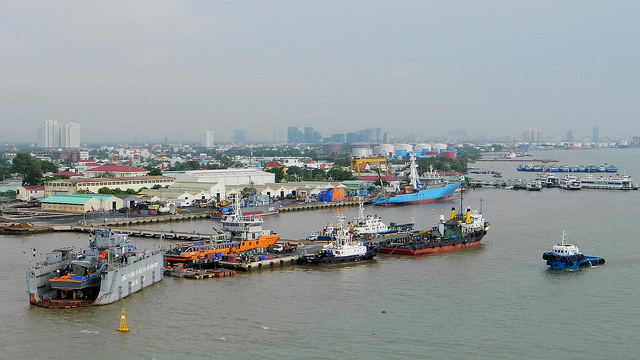
The city is currently home to 38 seaports with a total length of nearly 13 kilometers, including Tan Cang-Cat Lai, Sai Gon, and Sai Gon Premiere Container Terminal.
The city’s seaports handled 109 million tonnes of cargo and generated over VND15 trillion ($705 million) last year. Volumes at these hubs have been rising annually by 15.3%, attributed to the city’s investment in major transport infrastructure projects.
Photo: Allan Watt